
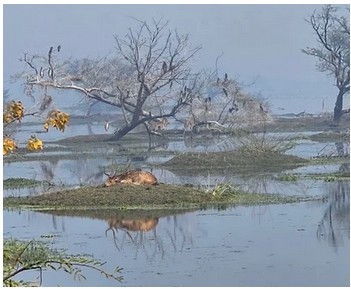
Keoladeo – five islands receding in a bird sanctuary in India – a fading bigger picture.
A messy market, with the tech bulls in charge, but deep uncertainty as the first half starts to wind down. A new Antwerp? We also cover Burnham’s ascent.
Scenarios
The Middle East is not dominating, perhaps it should? Markets are expecting Trump to get bored, leaving another global hotspot gently glowing. Oil starts to flow, but neither side is happy. Iran is stuck in limbo, and in due course will have to revert to more slaughter. The US steps back, to monitor and degrade Iran’s nuclear weapons. The caravan moves on.
After the summer the Gulf states slowly revive, boosted by the infrastructure spend needed to avoid the trouble spots, but hit by lost revenues. It is widely assumed the US Navy finds other occupations; a resumption of all out hostilities is being discounted.
I am struck by how extreme wealth, overlapping littoral states, religious dissent, outside interference, and dynastic struggles, managed to take Antwerp, once the great North European port, and cast it aside to centuries of neglect – simply by shutting the Scheldt.
It never revived, though after centuries, it stabilised. But the great ports of Northern Europe had shifted North, to Rotterdam and Amsterdam : a more liberal religious settlement, closer access to the sea lanes, further from the fighting.
Could the Gulf, as a maritime route, be lost in much the same way? Being too difficult to live near never helped Baghdad and Tehran, once great trading centres.
Meanwhile green zealots do adore the closing in of carbon reserves, the destruction of carbon demand, the funding boost to renewables – climbing onto a bandwagon –
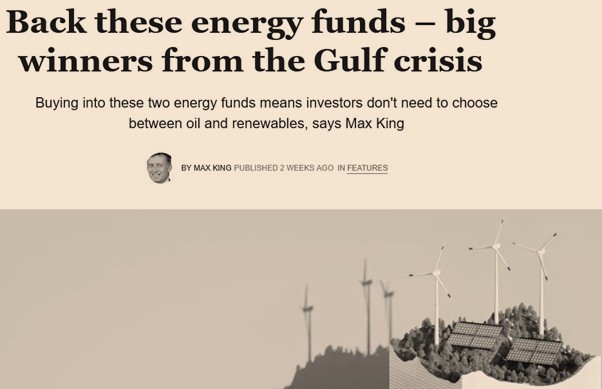
Clipped from MoneyWeek-find article at this link
We have long argued that it makes no sense for a “green” UK government, to let the real price of petrol drift down. Nor do subsidies ever help, they simply discourage substitution, force prices up for other consumers, and stop necessary investment. At least be consistent?
So, is the market’s seeming indifference to a massive oil price shock, a question of faith in Trump, resigned acceptance, backdoor environmentalism, or folly? How do I assign weights to these outcomes?
Good old Donald coming through? Well perhaps over 50%. But multiyear stalemate is possibly 20%, I feel higher than the market now sees. And of course, a new war, but not till the autumn fighting season, is possible. In short, more risk than markets indicate.
Inflation is back, but is being ignored.
What does worry investors is inflation; they expect rate rises. I see the threat as more fiscal, as long as governments keep expanding, rates will stay high. We get a lot of guff on borrowings, about trends and percentages, but gross borrowing only ever goes one way and is not sustainable.
From an equity viewpoint, rate rises make value stocks, which need a higher dividend to be justified, and anything carrying a lot of debt: less attractive. While any strong secular trend is still likely to surmount still modest inflation fears.
Which is part of why we have AI related stocks soaring, and rate sensitive stocks (property, housebuilders) collapsing.
Retreating from the brink
I no longer expect a clean exit from either Russia or Iran (and maybe was foolish to hope), and now, at best, stagnant interest rates; I am growing more careful into the summer. Moving my target cash levels up from 10%.
I am also aware that quite rightly, the strongest market is the one most impacted by AI investment, least impacted by oil imports. Markets that miss on one or both (Europe, India) are not fun. So far markets like Korea which both import a lot of oil and have a big AI benefit are jumping around, but overall, the tsunami of cash for AI is lifting them. Markets that are dominated by oil stocks, as in parts of Latin America, seep away when optimism returns.
Fading Starmer
I never expected Starmer to just fold, but nor will his party tolerate his leadership into the next election. He should stop gaming the system, stop childish and demeaning gimmicks like playing with VAT rates.
While Burnham says so many different things to different people, no one knows what he thinks. A smooth, charming, engaging chameleon, after a dull strait-laced failure, we now seem to be re-cycling through recent UK leadership history at speed.
I expect the Makerfield by-election (June 18th) to be a challenge for Labour, but few others do, certainly not Kalshi, the prediction market. Partly because the right has split again, a noisy Restore will now steal some Reform votes. Voting for the next Prime Minister of course feels like an important responsibility – so expect good turnouts.
The left wing also still dominates local Labour parties, so cut off from real power by Starmer, they are after revenge. For markets it rather depends on Burnham’s Cabinet, to come sometime in the autumn. He likes to be liked, does not like to think too hard – English at Fitzwilliam, unlike Streeting’s History at Selwyn.
Maybe he would enjoy this, from Thomas Hardy, on the bloody folly of certainty;
Overall, I am not sure we get many disasters in the UK for the rest of Labour’s term, but debt will be a weak point. And expect more tax.
In our heart of hearts believing
Victory crowns the just,
And that braggarts must
Surely bite the dust,
Press we to the field ungrieving,
In our heart of hearts believing
Victory crowns the just.
Plus, it will likely be hitting London hard, something Manchester loves to do.
It all comes back to the Gulf, markets may no longer fear the worst, but that’s about it. We also (as all bull markets do) have greedy private investors, including Musk, about to tap colossal liquidity to line their pockets, which means something quite chunky (and liquid) has to be sold elsewhere. That will create damaging volatility.