

Hunting bird – edited from in house photograph
Well, that was a splendid summer, at least if you were not caught in the office. Did anything happen? Not obviously; the US kept growing, Europe kept stagnating, the Far East kept booming. The Middle East kept fighting, when it was cool enough. So did the Slavs.
The great post COVID cycle rolls on, state deficits keep rising, no one can face the cost of forcing COVID inflation out of the system. Electorates keep dreaming. Investors keep riding the fiscal wave.
Still About Rates
The geeks and nerds on their valuation models care about rates, the real world cares less. If a 60/40 model is creating 20% annual returns, and pure momentum models hitting 40%, do we care if the Fed Fund rates move by twenty-five basis points? 400 basis points, maybe, but 25, 50, 100 who cares?
Some of inflation stems from mispriced capital. I would rather see rates at higher levels, allowing sensible real, post inflation returns, and some significant time value for money. Is the risk of investing in US Treasuries for thirty years, only 1% per annum higher than doing so for two years? I don’t think so.
The thirty-year rate for the UK or Europe, in a sane world, would also be higher. Everything outstanding at the long end, in the UK, was issued below current rates, so the actual impact is minimal, unless we issue more. Why would we? Equally as every holder of a UK long bond, acquired at issue, is now under water, who would buy them? The last new issue, the 2056 5.375%, was on May 21st 2025. Hardly current!
It would take an almighty scare to knock investors out of equities, back into bonds. Nor are those holding bonds now that keen to get out, given positive real returns, unless there is a real credit threat.
An odd equilibrium. But bonds are not toxic here. Some US equities are expensive, but globally few are, given growth.
Echo Chambers
Jackson Hole came and went. Warsh, the new Fed Chair, gave pretty much the same hip Californian economics professor (Stamford) speech he gave after the prior two Fed meetings. Largely to the same bunch of smart looking journalists, with respectable English degrees, Masters in Journalism and near zero commercial experience. All herding along together, hoping that cohesion would stop them being fired, or worse, made to cover real news.
Each iteration of the same speech created lots of tales of inconsistency, baffled markets, filling the requisite summer columns. Hogwash, all of it. All Warsh is suggesting is back to basics and checking the data.
It is hardly a thriving institution he inherited, vast amounts of mission creep, core target not met for seven (!) years, and a ton of infighting and politics. It looks to me, as if he has assessed the risks and knows a rate rise (the only viable choice) can be left a few more months. There is no runaway inflation train, nor can there be when employment is pretty stagnant, if erratic. Yes, Friday’s US jobs number was hot, but the last two were pretty cold, and wage inflation is still falling.
Sure, he can do performative single rate rises, but he really needs to know where the whole show is heading. Perhaps a rise in September, perhaps two this year, given the market has already priced that in; it hardly matters. The two year is already 75 basis points above the overnight rate.
The real questions should be all about AI, is it going to wreck the labour market? Wreck the capital markets? Be the next great wealth creation revolution? Or indeed at different times, all three? Or none of them?
At least, if he thinks, checks the basics, he should not be blindsided like dear data dependent Powell, who hopelessly missed the inflation target, at one point by 450%.
As for the Middle East, it is now a year since the first attack on Iran, time enough for some adjustment. I think the oil market price signals are probably working well, although given the opacity of China, OPEC, Russia, Iran, it is doubtful if anyone really understands supply.
Will this winter be tough? Yes, but more in natural gas and heating oil, than the lighter distillates that troubled the summer.
New Brooms
What about the Burnham bounce?
Well, it is real, although perhaps not his creation, after Sunak and Starmer, the arrival of a human being is a pleasing change.
The Burnham Bounce, illustrated by a poll
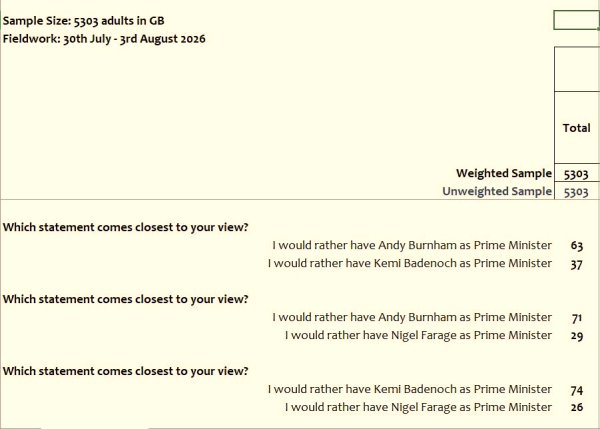
Political views as expressed in the Lord Ashcroft poll 3 August 2026 See this link
What does all this devolution, and greater state control of essential services mean? Blowed if I know.
But Andy is very well placed to know what is wasted by Central Government, and even better to know what is wasted by Local Government.
Starmer has handed him a once in a century chance to recast local government. In his slaughter of the district councils, he should be getting rid of about two thirds of top management and is scrapping a similar portion of councillors. But that downsizing, well handled, could release a lot of badly needed talent, and jettison as much deadwood.
A reorganisation for the ages. But is he our Napoleon or Robespierre? The ruthless builder or the fey butcher. Or our Sturgeon, the comedy option?
There is no doubt that local government wastes a lot of time on central mandates, on meeting meaningless Treasury targets and on fudging various figures to look good. Too many low grade, venal, elected representatives, means too many hostages to local vested interests.
By contrast I do struggle with quite what his more state control means, without more state ownership, which he professes to be a lot less keen on.
I see this as more rigging the asset values, to drive market solutions. But also catching the fat cats: those talking public, acting private. That could be ugly, but that is not to say it can’t be done. But not without some deregulation or delayering.
A Stormy Autumn
So, nothing much has happened, but the course still feels set for destruction.
But not yet, very few sovereign states are having any real difficulty with financing, and those that are, often mismanaged resource states, can now see an exit.
AI blow ups still seem a way off too. So, jitters yes, but jitters are healthy signs of a thinking market.
I remain happy to wait for the mid-terms, and stay cautious.