
The new normal, more Old Labour, what is a ‘handle’, will property ever revive, how durable is the renewables bounce? When do numbers matter to us ?
Same old
It looks like the new normal is no Middle East peace, nor one in Ukraine, and interest rates stuck at about 4% or so. Looked at another way, nothing has changed for a long time.
For most of New Labour (1997-2010) rates were again about 5%, falling slowly from 6.25% to 4.5%. Then we had the curious hiatus from 2008 to 2022, with rates artificially held at near zero, but we are now back in that circa 4% world.
Liquidity looks fine, but is not, as it is all hot money now, speculative flows mostly. For anything longer than yesterday afternoon, money costs a lot more.
I am not sure that will change much now.
Commentators missed a key piece of new Fed Governor Warsh’s press conference, his Wall Street use of the phrase “handle”. This simply means the number ahead of the decimal point. He explicitly said he is OK with inflation at 2.99%, which is still a “two handle”.
Data suggests he is already not far off that, maybe a gentle tap to keep markets honest, one or two rises, but nothing dramatic is required.
Very old
As we said two weeks back, Burnham is the continuity Labour leader, the successor to Brown, before he mucked it all up. While markets like the rumour of Mahmood as Chancellor, and she fits the brief as Oxford educated (Lincoln), and on the right of the party, in other words not completely off with the fairies, but is in other ways less positive.
Ed Miliband while crazy on Net Zero, was at least clearly numerate. Like Thatcher, he thinks the natural world is reducible to formulae, and we actually know what those are; a dangerous illusion. But he can still add up.
Mahmood, a lawyer, does not need that skill. So, like Powell and Lagarde, a fairly brutish “data driven/rear view mirror” reign is likely now. The downside of her move is getting Ed Miliband as Foreign Secretary, peddling all kinds of nonsense; more Chagos like stunts.
Although maybe it also means we will reverse some of the structural blind alleys Blair drove us into?
However, this will be a very Trade Union led government, so unlikely to solve our productivity issues.
Nor will it be more local – on Friday afternoon, nice Andy green-lit the chopping of over 100 District Councils; in Gloucestershire alone over two hundred and fifty elected representatives gone. This is far from more representative localism.
But we will be happier, we can only welcome a Prime Minister not driven by faction, for the first time since Blair. I take at face value his desire to be less adversarial.
Do I also detect a respect for the role of Prime Minister: not racing round the podium to play every solo himself, but trying to hold it all together. If he appoints ministers and lets them get on with it, all sides gain.
So, if this is a change, it is a welcome one. Reform and to some extent Kemi made a strategic error in focusing on Starmer rather than their own positions. It is now easy for Labour to dismiss Keir and Reeves as irrelevant errors.
If they keep slugging away at Burnham’s personality, it will be long three years, and to a degree exactly what he wants.
Dented haloes
Value Investors have had a pretty good ride, overall, this year, with Emerging Markets, Smaller Companies and the so-called HALO (Heavy Assets Low Obsolescence) trade. I regard this as generally another bit of Wall Street nonsense. The problem with owning anything tangible has been the speed at which legal, regulatory and political decisions destroy returns, which shows no signs of stopping.
Yet, for all that UK and European Real Estate just droops lower. If this was just interest rates, renewables (with their own damaged halo) would have done the same, but they have shown a modest bounce.
It feels short term, sentiment driven. A supportive Government does not mean a generous Treasury, and the “build it and they will come” idea is deeply flawed.
Even the big boys, like SSE, are spending far more on transmission and distribution than renewable generation, indeed writing off wind licenses and permits, because they are in the wrong place. While spending £22bn in Northern Scotland, given the underlying economy, seems reckless. A lot of social spend is being knitted into real capex to export wind energy.
So, I am not convinced the sector recovery lasts much longer than a typical Iranian ceasefire.
UK Property
Reading a swathe of half a dozen March year end accounts (UK REITS largely report then) they all start to merge into one : a story of scrabbling to stay in place, falling debt levels, masked by rising interest rates. Better earnings, higher occupancy, the exiting from multi-year development plans, seem to count for little, and of course rising tax and costs soak those income gains up.
If you’re pedalling hard to stand still, with your paper useless, banks not interested, costs cut to the bone, it is getting hard to justify high remuneration costs. I would like to find villains and saints, but when the sector is stuck, everyone is. At least shareholders get high dividends to wait, and those look sustainable. History says buying prime London property at a discount is seldom an error, but history is apparently wrong.
The related, but not identical, housebuilders are in a similar place, so heavily taxed and milked for goodies to local government, they struggle to advance. Their land banks are very hard to value, given their dependency on the state licensing system.
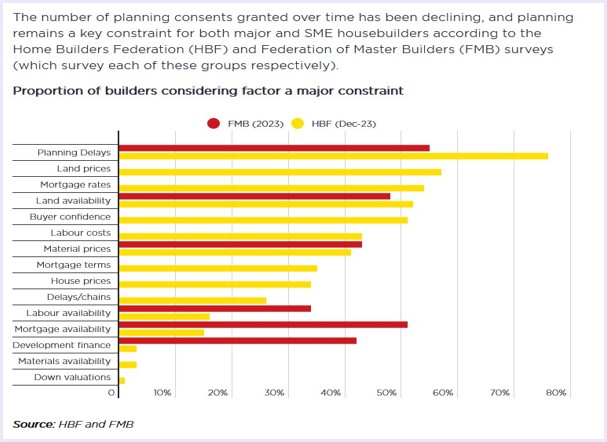
HBF – Housebuilders Federation (larger players) and FMB (Federation of Master Builders) SMEs
From this page on the Savills blog.
Rules of thumb
Finally, some odd numbers. I was trying to work out what sum matters to me, in the face of RIT (Rothschild Investment Trust) offering a pretty mean-spirited tender, for about 10% of their shares at a 15% discount to net asset value. It includes Space-X, which is even harder to value now it is quoted, but not tradeable, due to lock ups.
A colleague suggested a timeless measure of “should I bother” was a pint of beer a week. Which seemed a neat way to have an adjustment for both inflation and region. That also feels about right, if any bureaucratic hassle and intrusive tax reporting are involved.
If it won’t buy a pint every Friday night, why bother?
With that, like the French, the Snipe has vanished for August.
We will return to a much-changed world on 6th September, no doubt.
Have a good summer.